


TL;DR
Anti-counterfeit technology works in four layers: overt features anyone can see, covert features trained staff can check, forensic markers that need a laboratory, and digital codes that link each product to a database. No single layer is enough, and anything printed can be copied. The useful question is what happens when it is.
Counterfeit and pirated goods worth about US$467 billion were traded internationally in 2021, up to 2.3% of world imports (OECD and EUIPO, 2025). Brands that protect themselves well combine a visible deterrent, a check that customers and inspectors can run, and a record of where their products actually turn up.
This guide compares holograms, security inks, taggants, QR codes, secure QR, serialization, NFC, RFID, AI image recognition, blockchain certificates and closed-loop codes, then covers vendor questions, costs, rollout steps, common mistakes and where the EU Digital Product Passport fits.
How big is the counterfeiting problem in 2026?
The best current measure is the OECD and EUIPO report Mapping Global Trade in Fakes 2025, published in May 2025. It estimates that counterfeit and pirated goods worth about US$467 billion were traded internationally in 2021, up to 2.3% of world imports. For imports into the EU the share was higher: about US$117 billion, or 4.7%.
Clothing, footwear and leather goods made up 62% of seized fakes, and about 65% of seizures involved small parcels and mail. That matters when you choose technology. Fakes increasingly arrive one parcel at a time, sold through marketplaces and social media, so a feature that only a customs officer can check will miss most of them.
Enforcement figures point the same way. EU authorities detained about 112 million fake items worth over €3.8 billion in 2024, a record value (EUIPO, 2025). In Australia, the Border Force seized more than 700,000 counterfeit items worth over A$35 million in FY2024/25, and the Australian Institute of Criminology puts the local counterfeit market at about A$5 billion.
What the headline numbers leave out
OECD figures cover international trade only. They exclude fakes made and sold within one country, and they do not count lost trust, product liability or the cost of investigations. Treat them as a floor, not a ceiling.
What are the four layers of anti-counterfeit technology?
Security specialists group features by who can check them and what the check takes. Each layer answers a different question, which is why mature programs use more than one.
| Layer | Who checks it | Examples | Strength | Weakness |
|---|---|---|---|---|
| Overt | Anyone, by eye | Holograms, color-shifting ink, tamper-evident seals, visible codes | Deters casual copying and reassures buyers | Copied quickly; most shoppers do not know what the genuine feature looks like |
| Covert | Trained staff with a simple tool | UV or infrared ink, microtext, hidden images | Cheap to add and hard to notice | Works only while it stays secret; few people can check it |
| Forensic | A laboratory or specialist reader | Chemical, DNA or molecular taggants; isotopic origin testing | Strong evidence for customs and court | Slow, costly per test, sampled, and not usable by shoppers |
| Digital | Anyone with a phone, backed by a database | Serialized QR, secure QR, NFC, RFID, closed-loop codes | Every check creates data and it scales to every unit | Only as strong as the protection against cloning, or the detection of clones |
A common pattern is an overt or digital feature for customers and channel partners, backed by a covert or forensic feature that investigators can rely on when a case goes to customs or court.
Overt features: holograms, security inks and tamper-evident labels
Holograms have been the default Anti-counterfeit label for decades. Basic holographic foil is easy to buy, and copies good enough to fool a shopper who has never seen the original are common. Custom origination with fine detail is harder to copy well, but it still depends on the buyer knowing what the genuine hologram should look like.
Color-shifting and other optically variable inks change color with the viewing angle, the same idea used on many banknotes. They raise the cost of copying and give an instant visual check, but like holograms they rely on the person checking to spot a difference.
Tamper-evident labels, such as void labels, destructible film, breakaway caps and seals, show that a pack has been opened. They are valuable against refilling and product substitution. They prove opening, not origin: a counterfeiter making a fake from scratch simply applies an intact seal. Our article on tamper-evident labels covers this in detail.
Use overt features as a deterrent and a quick visual check, and pair them with something that can be verified.
Covert and forensic features: taggants, markers and lab tests
Covert features include UV and infrared inks, microtext and hidden images that need a torch, loupe or filter to see. They are cheap and useful for distributor and customs checks. Their protection is secrecy, and once a feature is known across a supply chain, counterfeiters tend to learn it too.
Taggants and forensic markers go further. Microscopic particles, chemical or DNA markers and molecular markers can be added to inks, labels, plastics or the product itself, then confirmed with a specialist reader or in a laboratory. Origin testing uses a product's natural chemical fingerprint, for example the isotopes in food or cotton, to show where it came from.
These are the strongest layer for evidence. A lab result is hard to argue with. The tradeoffs are that shoppers cannot check them, tests are sampled rather than run on every unit, each test has a cost, and a marker on its own does not tell you where your products are turning up.
QR codes, serialization and secure QR: what do digital codes prove?
A plain QR code is free to make and any phone can read it. That is its strength for sharing information and its weakness for security. A photocopied QR code works exactly like the original, and a counterfeiter can print their own QR code that points to a lookalike website. See can QR codes be counterfeited? and our Securicode vs QR code comparison.
Serialization gives every unit its own number, usually a GS1 GTIN plus a serial number in a Data Matrix or QR code. It is required for prescription medicines under the US Drug Supply Chain Security Act (DSCSA) and the EU Falsified Medicines rules (EU FMD). Serialization identifies each item and enables track and trace. The code itself still uses an open standard, so it can be photographed and reprinted. Detection depends on the brand noticing the same serial number being scanned more than once.
Secure QR codes add a security element. The most common is a copy detection pattern: fine printed detail that loses information when it is photographed or reprinted, so a scanning app can judge whether it is looking at an original print. Digital watermarks hide a similar signal across packaging artwork. These can flag some copies on the first scan, which is a real advantage. They usually need controlled, high-quality printing, and results can vary with print quality, lighting and camera.
NFC and RFID: when do chips make sense?
RFID tags are read by radio, often several meters away and many at once. They are excellent for stock counts, receiving and loss prevention, which is why apparel retailers use them widely. Standard RFID tags were designed for identification rather than authentication and can be cloned unless they use security features.
NFC is a short-range form of RFID that a phone reads by tapping within a few centimeters. Secure NFC chips can answer a cryptographic challenge with a different response each time, which makes cloning much harder than copying a printed mark. Tamper-loop NFC tags can also show when a bottle or box has been opened.
The tradeoffs are cost and fit. A chip costs more per unit than a printed code, encoding adds a step, and many programs carry platform fees. Chips need space and a suitable surface, and metal or liquids can interfere with reading. For high-value goods where a tap experience matters, secure NFC is a strong option. For high-volume or small products, it can be hard to justify. Our Securicode vs NFC and RFID comparison goes into detail.
AI image recognition and blockchain certificates
AI image recognition uses a phone camera or imaging device and a trained model to judge whether an item is genuine. Some systems examine the product itself, such as stitching, materials and microscopic surface texture. Others read a printed pattern. This approach is widely used for luxury resale, where there is no code to check. Accuracy depends on the training data, results are probabilities rather than a yes or no, and new products need new data. Many services charge per check.
Blockchain certificates record a product's origin or ownership on a shared ledger, where entries are hard to alter after the fact. They are useful for ownership transfer and resale history. A blockchain only knows what it is told, though. A certificate can be linked to a fake as easily as to a genuine product, so its value depends on a reliable physical link, such as a chip or code, between the record and the item.
How do closed-loop authentication codes work?
A closed-loop code reverses the open model. Only the issuer can create working codes, and every check goes back to the issuer's own database rather than to an outside web link. A made-up code fails. A copy of a real code still points to one genuine product, so when that code is scanned too many times, or in two places it could not physically be, the copy is exposed.
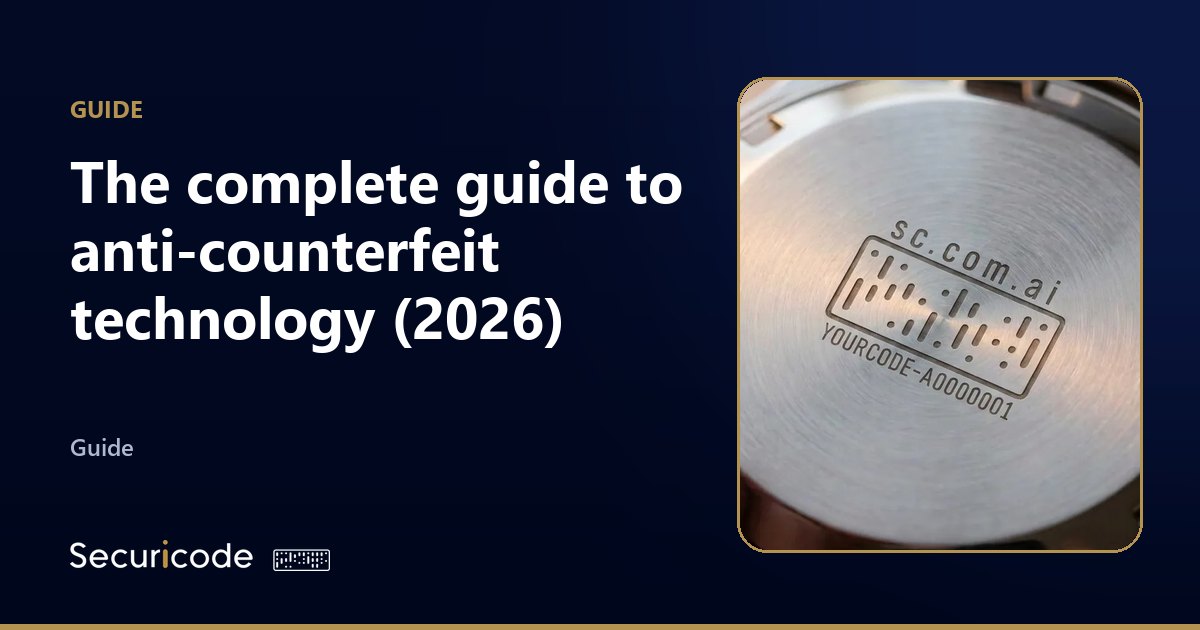
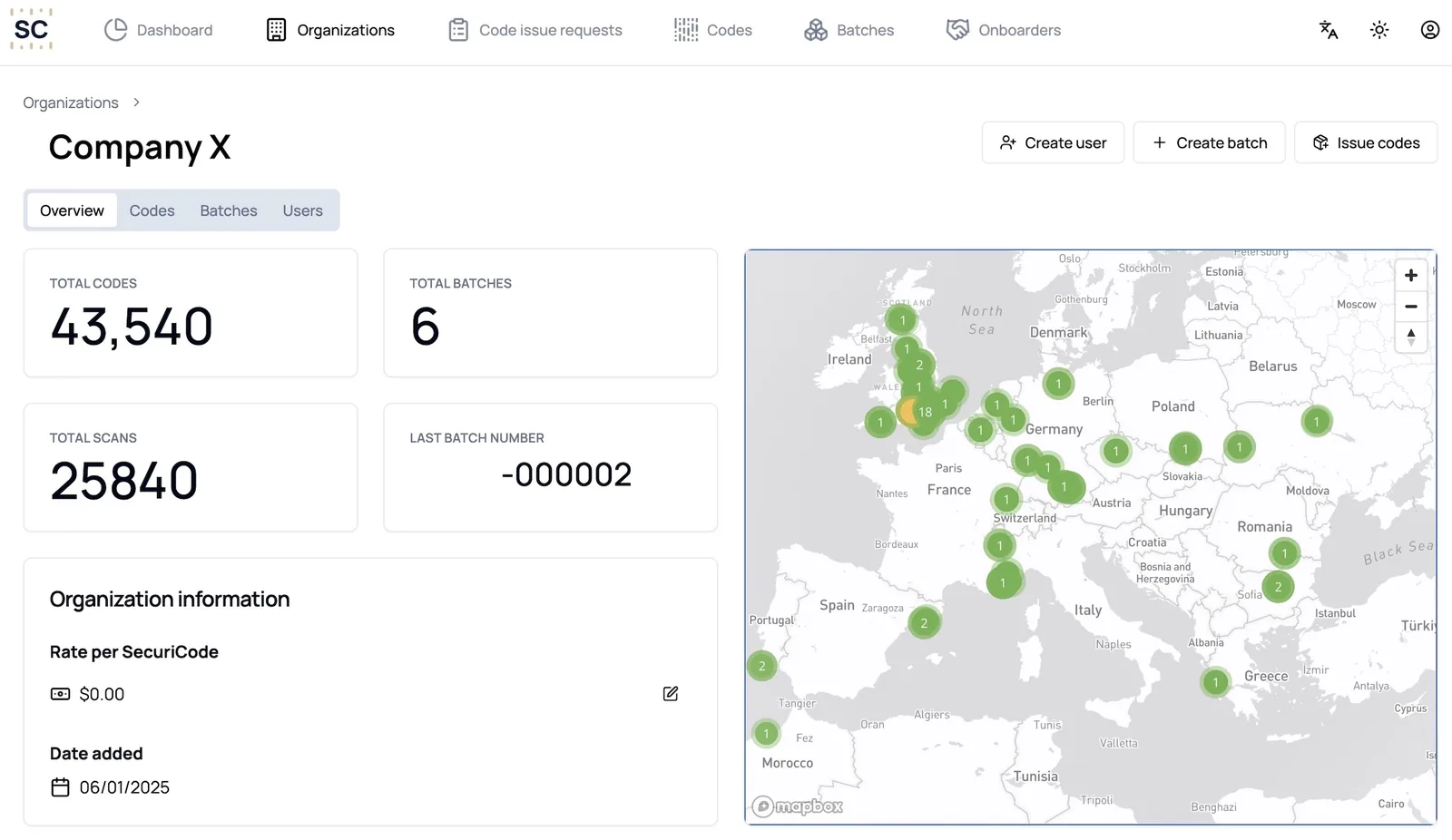
Securicode is a closed-loop code. Codes are issued only to brands Securicode has vetted and approved, from a code space of more than a quadrillion, using a patented code design. A code is phone-scannable at 1.2mm, so it can be printed, laser-etched or woven onto the product itself rather than only the packaging. Anyone can check it with the free Securicode app, and every scan is logged with its time, date and location. The brand's dashboard shows each code as a map dot that changes color every 10 scans (green, yellow, orange, then red over 30), and flags impossible movement.
Be clear about the limits. Any printed mark can be photographed and reprinted, and the first scan of a copy can look genuine. Detection gets stronger as scans accumulate, so closed-loop codes work best when distributors, inspectors and retail staff scan at key points, not only consumers. Verification happens in the Securicode app, not a phone's default camera.
Read more about how closed-loop authentication works.
How do anti-counterfeiting solutions compare?
The table below summarizes the options. Costs are relative because real prices vary widely by volume, specification and vendor.
| Technology | Who can check | Relative unit cost | Can a counterfeiter copy it? | What happens to copies | Data from each check |
|---|---|---|---|---|---|
| Hologram | Anyone, by eye | Low | Basic foils easily; custom designs with effort | Nothing is recorded | None |
| Security inks and microtext | Trained staff | Low | With effort, once the feature is known | Nothing is recorded | None |
| Taggants and forensic markers | Lab or specialist reader | Medium to high per test | Hard | Found when a sample is tested | Lab report |
| Plain QR code | Anyone | Very low | Yes, instantly | The copy works the same | Only if the brand adds tracking |
| Serialized QR or Data Matrix | Anyone with a suitable app | Very low | Yes, though each serial is unique | Duplicates show if scans are logged | Scan records, depending on the platform |
| Secure QR (copy detection) | A specific app or scanner | Low | Harder to copy accurately | Can be flagged on scan | Scan records |
| NFC with a secure chip | Phone tap | Higher | Hard | Clones fail the cryptographic check | Tap records |
| RFID (UHF) | Fixed or handheld reader | Higher | Standard tags can be cloned | Depends on the chip | Inventory reads |
| AI image recognition | App or service | Varies, often per check | Depends on the model and product | Flagged as a likely fake | Result per check |
| Blockchain certificate | Anyone with the link | Varies | The record no; the physical link depends on the carrier | Depends on the carrier | Ownership history |
| Closed-loop code (Securicode) | Anyone with the free app | Cents on the dollar | Cannot create working codes; can photograph one | Flagged by scan count and impossible movement | Time, date and location of every scan |
For a shorter side by side view, see anti-counterfeit technologies compared.
How do you choose? Questions to ask every vendor
Start from the threat, not the technology. Lookalike brands are a trade mark problem. Refilling calls for tamper evidence. Diverted stock needs codes linked to shipments and locations. Superfakes need checks on the product itself. Online listings need marketplace monitoring. Once you know which problems you have, ask every vendor the same questions:
- Who can create a working code or tag, and how do you stop a counterfeiter from becoming your customer?
- What happens the first time a copy is scanned? What about the tenth time?
- Can the feature go on the product itself, or only on packaging that gets thrown away or reused?
- What is the full cost at our volume, including setup, platform, per-scan and integration fees?
- Who owns the scan data, where is it stored, and how long is it kept?
- Does it work with our printers, label converters and packaging lines without slowing them down?
- How does a shopper or inspector check a product, and what do they see?
- Has the security been independently tested, and can we see a summary?
- What happens to our codes and data if we leave, or if you stop trading?
- Does it work alongside GS1 barcodes and a Digital Product Passport?
- Can we speak to a customer in our industry?
Any vendor, including Securicode, should be able to answer these in writing.
What does anti-counterfeit technology cost?
Unit price is the number vendors lead with, and it is rarely the whole cost. Printed features usually cost the least per unit, chips cost more, and forensic testing is priced per test. Smithers estimates that brands spent about US$4.0 billion on authentication, tracking and tamper features in 2025, rising to about US$5.0 billion by 2030 (Smithers, 2025), which gives a sense of the real market behind much larger packaging headlines.
When you compare quotes, add up the total cost of ownership:
- Artwork, label or packaging changes, and any new printing or coding equipment
- Setup and integration with your production line and systems
- Platform, subscription and per-scan fees, over several years
- Telling customers and channel partners how to check
- Staff time to investigate alerts and act on what you find
Securicode codes cost cents on the dollar, with no minimum order, no management fees and no ongoing costs, and codes stay live forever, even if you never use us again. See how pricing works, or estimate what counterfeiting may cost you with the counterfeit loss calculator.
How do you roll out anti-counterfeit technology?
A pilot on one product and one market tells you more than any sales presentation. A sound rollout follows these steps:
- Map the threat. Where are fakes or diverted stock appearing, which products, and through which channels?
- Choose a pilot product and market where you already suspect a problem, so the pilot can show results.
- Decide placement: on the product, the label, the capsule or closure, and whether to link items to cases and pallets.
- Test printing and scanning on your real materials and production line before you commit to volume.
- Brief distributors, retail staff and customs, and tell customers how to check a product.
- Agree a response plan for alerts: who investigates, what evidence you keep, and when legal action starts.
- Review the results with your team, then extend to more products and markets.
What mistakes should you avoid?
Most failed programs fail for the same handful of reasons:
- Relying on a feature nobody checks. A covert ink with no inspection routine is a cost, not a control.
- Buying on unit price alone. Platform fees and staff time often outweigh the price of the label.
- Assuming a QR code or passport code proves authenticity. Open codes identify products; they do not prove a particular item is genuine.
- Protecting only the outer packaging. Cartons get discarded and genuine bottles get refilled. Mark the product or the closure where you can.
- Having no plan for alerts. Decide in advance who acts on a flagged scan and how.
- Promising customers more than the technology does. Absolute claims that a feature can never be copied invite scrutiny and erode trust when tested.
- Ignoring the gray market. Diverted genuine stock often travels the same routes as fakes. See gray market and parallel imports.
Where do the Digital Product Passport and online brand protection fit?
The EU Digital Product Passport (DPP) is a digital record of a product's composition, sustainability and compliance data, required product group by product group under the Ecodesign for Sustainable Products Regulation, Regulation (EU) 2024/1781. Its data carrier must follow open standards and be readable without a proprietary app, and the data carrier standard, EN 18220, leaves security features out of scope. A DPP tells you what a product should be. It does not prove that a particular item is genuine. The battery passport applies from 18 February 2027, and the textiles delegated act is expected in Q3 to Q4 2027. Our Digital Product Passport guide explains the dates and the gap.
Online brand protection monitors marketplaces, social media and domains for counterfeit listings and requests takedowns. It finds where fakes are sold online. Physical product authentication proves which items are real and gives you scan records from the real world. The two are complementary: listings tell you where to look, and scans tell you what you found. See our anti-counterfeiting solution for how Securicode fits.
Key takeaways
- Counterfeit trade was worth about US$467 billion in 2021, up to 2.3% of world imports (OECD and EUIPO, 2025).
- Use layers: an overt or digital check for customers and partners, and a covert or forensic feature for evidence.
- Anything printed can be copied. Judge each technology by what happens when it is copied.
- Compare total cost of ownership, not unit price: fees, integration and staff time matter more.
- A Digital Product Passport describes a product; it does not prove an item is genuine.
- Pilot on one product and market, with an alert response plan, before you scale.
Sources
- OECD and EUIPO, Mapping Global Trade in Fakes 2025
- OECD press release: global trade in fake goods reached US$467 billion (May 2025)
- EUIPO, EU enforcement of intellectual property rights: results for 2024
- Parliamentary Library of Australia, Bills Digest No. 57, 2025/26 (ABF seizures)
- Australian Institute of Criminology, Special Report 55
- Smithers, brand protection security packaging to reach US$5 billion (2025)
- EUR-Lex, Delegated Regulation (EU) 2016/161 (EU FMD safety features)
- US FDA, DSCSA implementation
- EUR-Lex, Regulation (EU) 2024/1781 (ESPR)
- EN 18220:2026 summary (DPP data carriers)