


Industries: luxury and fashion
Luxury authentication on the product itself
Superfakes beat the eye. A code only your brand can create, built into the product, gives buyers and your legal team something better than an opinion.
In short
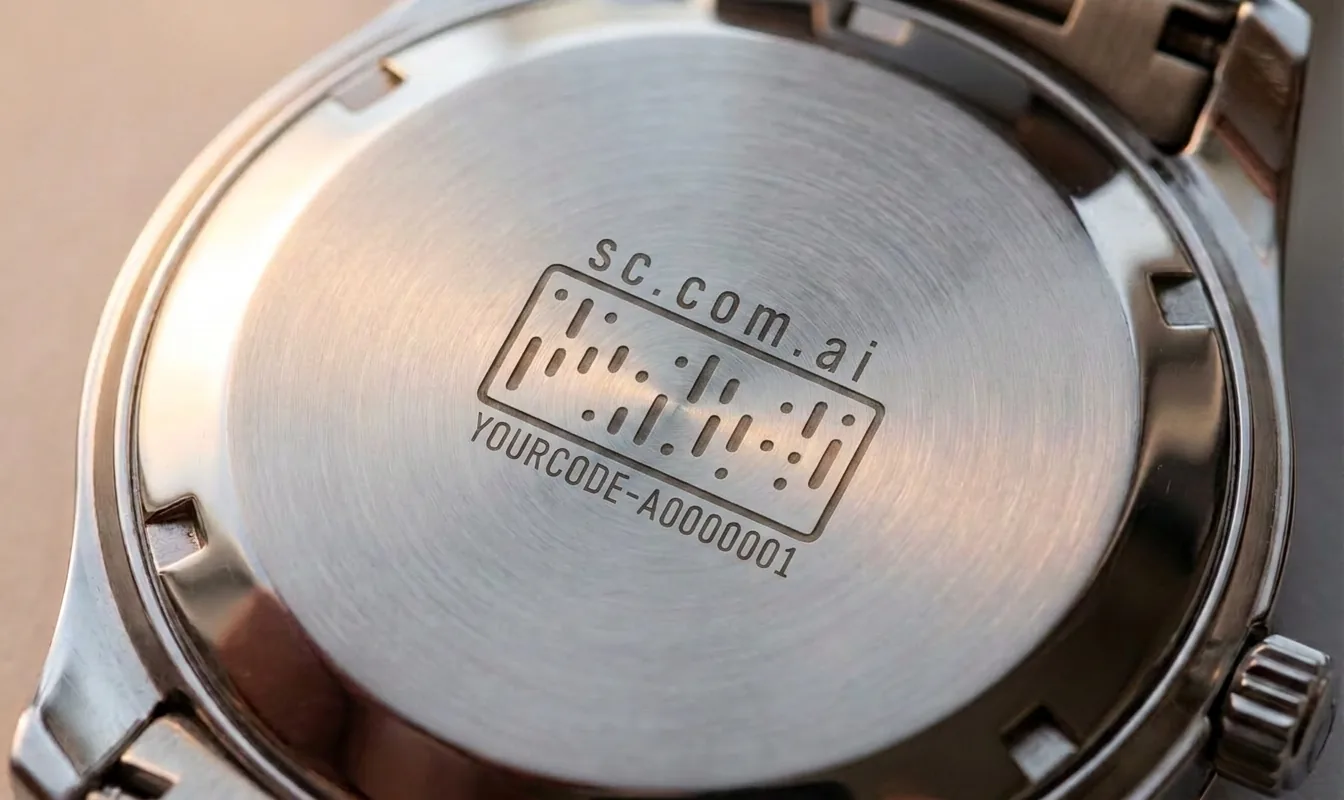
Luxury goods authentication usually means an expert or an AI service judging a bag or watch from its materials and details, often after it has been sold. Securicode puts brand-issued proof on the product itself: a discreet code inside a lining, on hardware or laser-etched on metal, that only the brand can create. Anyone can scan it with the free app, and a copied code is flagged when it appears in two places.
Where does the code go on a luxury product?
At 1.2mm, a Securicode is small enough to place where it does not change the design.
Inside a lining
Printed on an internal label or leather tab, out of sight until someone looks for it.
On hardware
Etched on a clasp, buckle or zip pull, where it lasts as long as the product.
Laser-etched on metal
On a watch caseback, jewelry or a metal plate, using laser equipment many makers already have.
Woven or printed on fabric
Woven into a label or printed on fabric, and readable down to 3% contrast as fabric fades.
Why do superfakes beat visual inspection?
Superfakes are counterfeits made to such a high standard that experts struggle to tell them apart, sometimes using leather and hardware from the same suppliers as the genuine product (South China Morning Post).
That leaves brands and buyers in a difficult position. Authentication services judge stitching, materials and stamps, which is exactly what superfake makers study. One authenticator, Entrupy, flagged 8.4% of the handbag and sneaker submissions it checked in 2024 as not genuine (Entrupy, State of Fake 2025). That figure comes from its own sample, but it shows how often doubtful items reach the market.
A visual check asks, “Does this look right?” A brand-issued code asks a better question: “Did the brand make this exact item?”
Why resale changes the authentication question
Resale is growing faster than new luxury. Bain-Altagamma put second-hand luxury at about €50 billion in 2025, while the personal luxury goods market dipped to about €358 billion (Bain-Altagamma, December 2025). BCG and Vestiaire Collective expect second-hand fashion and luxury to reach up to US$360 billion by 2030 (BCG, 2025).
Every resale is a moment of doubt. In the BCG and Vestiaire Collective survey of 7,800 resale users, 70% said they value Digital Product Passports for authentication when buying, yet 65% had never heard of them (BCG, 2025). Buyers want proof from the brand, and most products carry none.
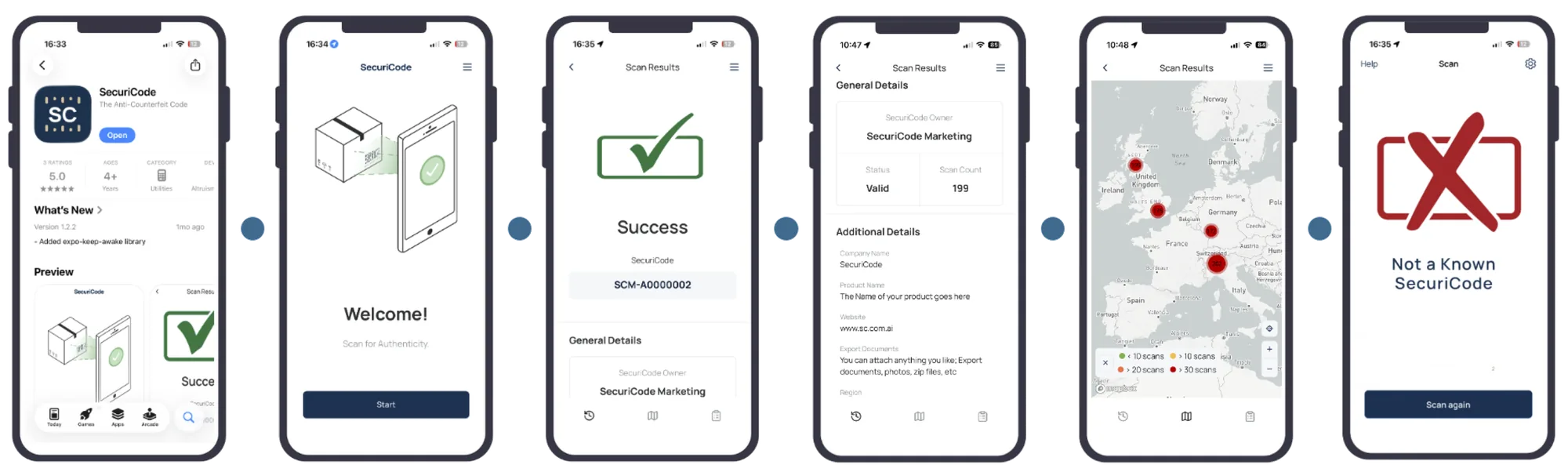
A Securicode stays with the product from first sale through every resale. Brands can also record a transfer of ownership against the code, so a resale buyer can see the item's history.
Why does brand-issued proof beat third-party guesswork?
| Third-party authentication | Brand-issued Securicode | |
|---|---|---|
| Who decides | An expert or AI model, judging the item or photos | The brand, which issued the code for that item |
| What it checks | Whether the item looks consistent with genuine examples | Whether this code was issued for this product, and where it has been scanned |
| Cost to the buyer | Often a fee per item or a subscription | Free app, free scan |
| When it works | After a sale, when someone asks | Any time, from first sale through every resale |
| Against superfakes | Hard when the materials match | A copied code is flagged by scan count and location |
| Evidence for the brand | Rarely shared with the brand | Every scan on your map |
Third-party authentication remains useful for older stock that carries no code.
Every scan is evidence for your brand protection team
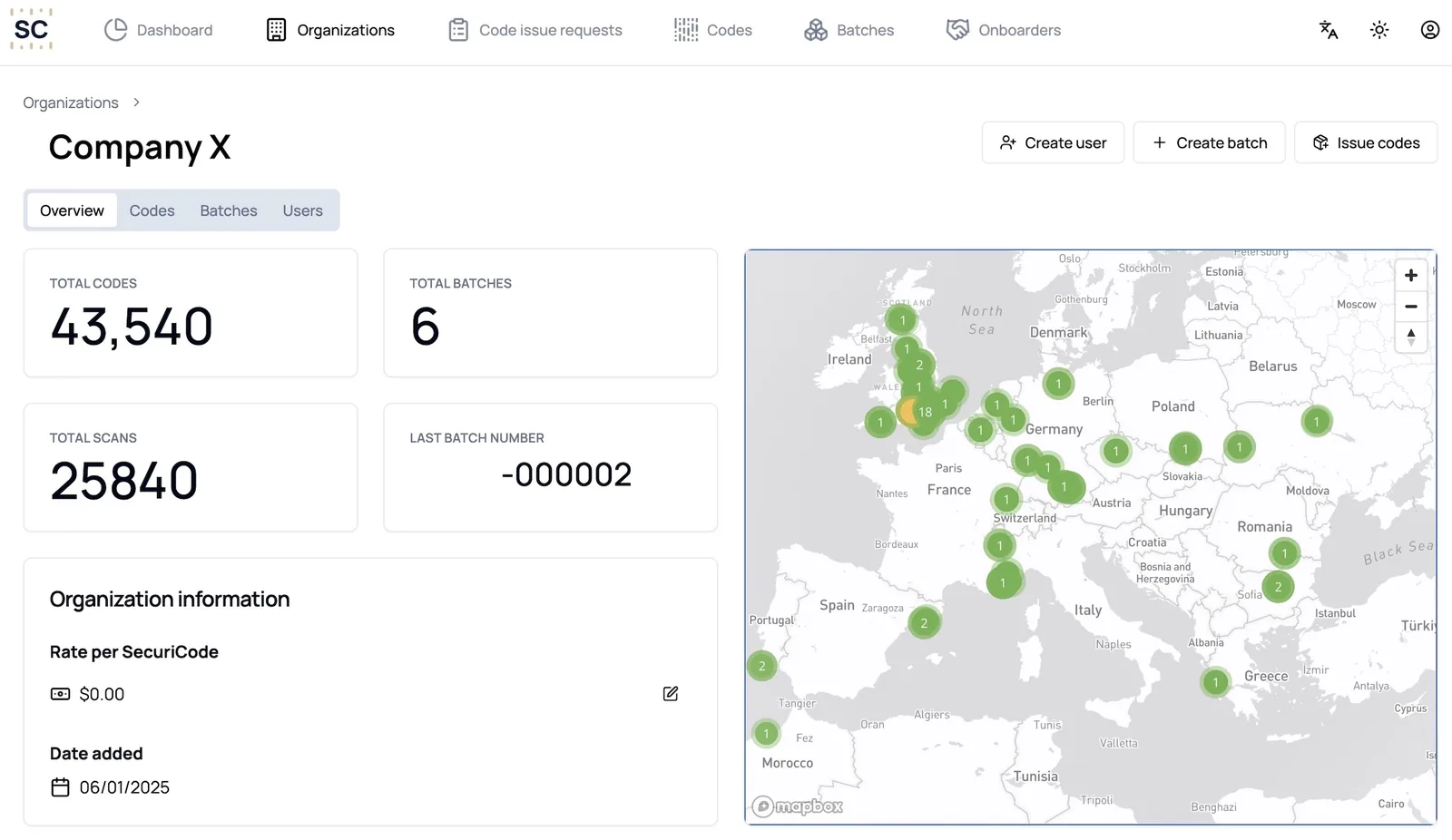
For legal and brand protection teams, each scan is a data point. A cloned code shows impossible movement, appearing in two cities hours apart. A batch meant for Europe scanning in an unauthorized Asian marketplace shows diversion. You get time, date and location records you can hand to investigators and lawyers.
You control who sees the data. Partners, investigators and law enforcement only see your portal if you give them access.
- Copies flagged by scan count and impossible movement
- Diverted stock visible by market
- Records you can share with investigators
- No ongoing fees per item or per scan
How luxury brands get started
- 1
Pick the lines most at risk
Start with the products that are copied most or resold most, where proof matters to buyers.
- 2
Choose placement with your product team
Lining, hardware, caseback or label. We help you test placement so the design does not change.
- 3
Apply codes in production
Printed, etched or applied by your existing suppliers, using codes issued only to your brand.
- 4
Tell customers how to check
A short card or care booklet line explains the free app, so buyers and resellers know where to look.
Frequently asked questions
How does bag authentication work?
Most bag authentication today happens after sale, by experts or AI services that compare a bag with known genuine examples. A brand-issued code adds a second route: if the bag carries a Securicode, anyone can scan it with the free app and see whether the brand issued that code for that product.
Will a code spoil the look of the product?
It does not have to. At 1.2mm, the code can sit inside a lining, on the underside of hardware or on a caseback, where it is found only by someone looking for it.
Can a superfake copy the code too?
A counterfeiter can photograph and reproduce a code from a genuine item. That code belongs to one product, so when it is scanned in two places, or far more often than one bag would be, it is flagged on your dashboard.
Does Securicode work for watches and jewelry?
Yes. Codes can be laser-etched on casebacks, clasps and metal plates, where they last as long as the piece.
Is Securicode a Digital Product Passport?
No. It is an authentication layer that can sit beside a DPP code. See how it works with the DPP.
Keep reading
Make every product provable
Apply for access to create Securicodes for your brand, or book a demo and we will show you a live scan.